
Perlancia Peptides
Perlancia Peptides restricts purchases to individuals conducting laboratory or institutional research and at least 21 years old. By entering, you confirm you meet this requirement.
All products offered on this website are sold strictly as research chemicals for in-vitro laboratory research use only. They are not drugs, foods, cosmetics, dietary supplements or medical devices, and they are not intended for human or veterinary consumption, diagnostic use, or therapeutic use of any kind.
Selecting “No” will take you away from this website. This confirmation will be remembered on this device for 30 days.
$24.00



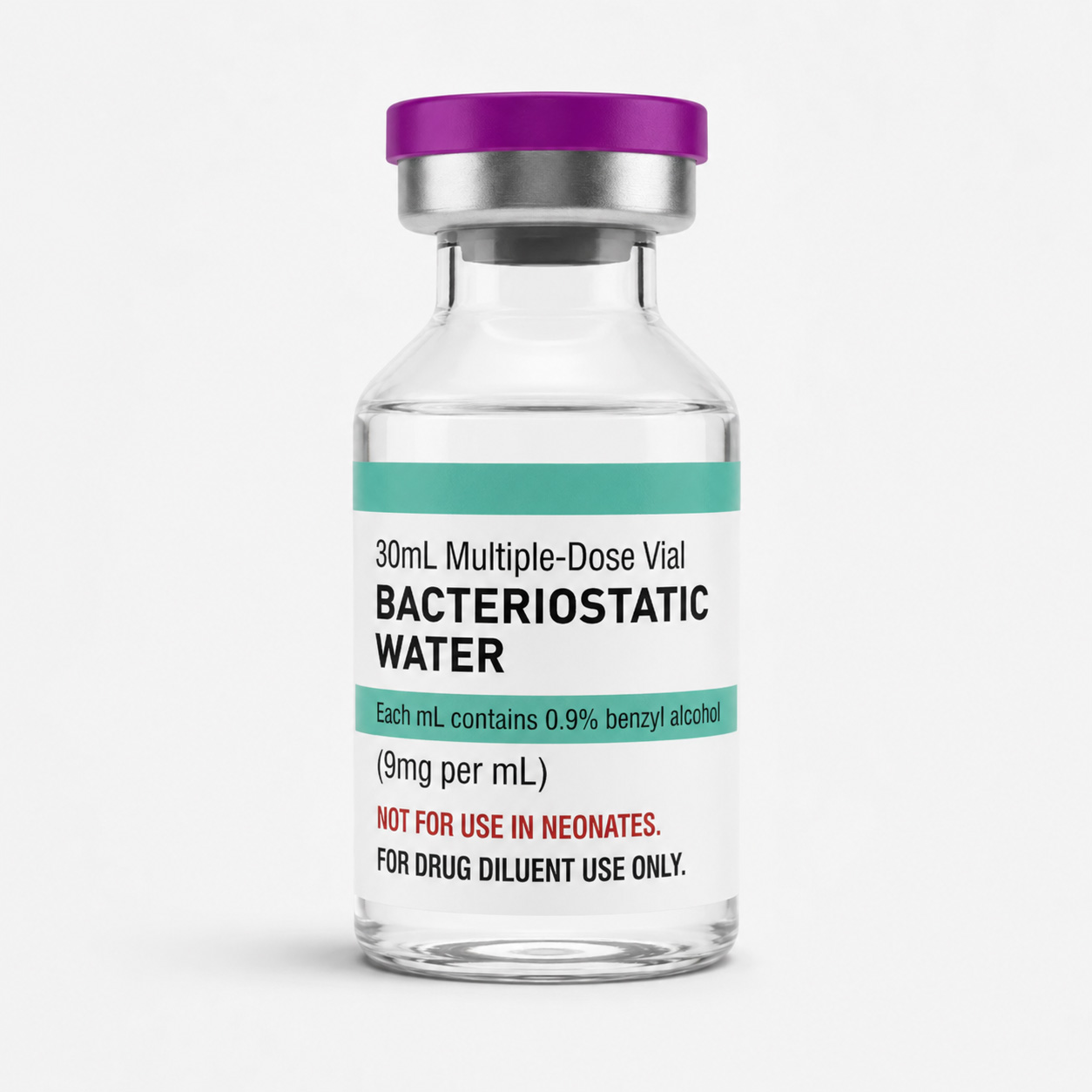
Bacteriostatic Water (BW) is a sterile aqueous solution containing 0.9% benzyl alcohol as a preservative agent. It is classified as a pharmaceutical-grade solvent and is widely used across laboratory and research settings as a reconstitution medium for lyophilized compounds. Unlike standard sterile water for injection, the inclusion of benzyl alcohol provides bacteriostatic properties that inhibit the proliferation of most bacteria, making it a preferred solvent in controlled research environments where multi-use vials are required.
Research applications involving bacteriostatic water span a broad range of laboratory disciplines, including biochemical assay preparation, in vitro cell culture support, and the reconstitution of lyophilized peptides and proteins for analytical study. Its chemical stability and preservative properties make it a foundational reagent in peptide and protein research workflows.
Bacteriostatic water has been studied and utilized across multiple laboratory research contexts:
Research has investigated the bacteriostatic mechanism of benzyl alcohol, the active preservative component in bacteriostatic water. Studies have explored its capacity to disrupt bacterial cell membrane integrity at the concentrations present in standard bacteriostatic formulations (0.9% w/v), effectively inhibiting bacterial replication without producing a fully bactericidal effect.
Research has further examined the compatibility of benzyl alcohol-preserved aqueous solutions with a wide range of peptide and protein compounds, with particular attention to:
Bacteriostatic water has been a foundational laboratory reagent across biochemical, pharmaceutical, and peptide research disciplines for decades. Its utility stems from the combination of sterile aqueous composition and benzyl alcohol preservative activity, which together create a stable reconstitution medium suitable for multi-use laboratory applications.
Scientific literature has documented its role in:
Its widespread adoption across research disciplines reflects its well-characterized chemical profile, established compatibility with a broad range of research compounds, and its role as a reproducible, standardized laboratory solvent.
FOR RESEARCH USE ONLY. This product is intended strictly for laboratory research purposes. It is not intended for human or veterinary use.
Bacteriostatic water has been a recognized pharmaceutical and laboratory reagent for well over a century, with its formulation standardized in pharmacopeial references including the United States Pharmacopeia (USP). The inclusion of benzyl alcohol as a bacteriostatic agent was developed to address the practical laboratory need for a preserved aqueous solvent that could be accessed multiple times from a single vial without risking bacterial contamination between uses.
As a reagent class, bacteriostatic water belongs to the broader category of preserved sterile aqueous solvents, distinguished from sterile water for injection (which contains no preservative) and from normal saline solutions (which contain sodium chloride as the primary solute). Its unique formulation makes it particularly relevant in research contexts where lyophilized compounds require reconstitution into a stable, multi-use aqueous medium.
The benzyl alcohol preservative has been the subject of independent scientific characterization, with research examining its antimicrobial mechanism, its compatibility with various compound classes, and its chemical behavior under different storage and handling conditions.
Lyophilized Peptide and Protein Reconstitution Research One of the most extensively documented research applications of bacteriostatic water involves its use as a reconstitution medium for lyophilized peptides and proteins. Research has examined the compatibility of benzyl alcohol-preserved aqueous solutions with a wide range of peptide compound classes, investigating structural preservation, solubility, and solution stability over defined laboratory storage periods. [INTERNAL LINK: Lyophilized peptide storage]
Antimicrobial Preservative Mechanism Research Scientific literature has characterized the mechanism by which benzyl alcohol exerts its bacteriostatic effect at sub-bactericidal concentrations. Research has explored its interaction with bacterial cell membranes, its spectrum of activity against common laboratory contaminant organisms, and the concentration thresholds at which bacteriostatic activity is reliably maintained.
Solvent Compatibility and Peptide Stability Research Researchers across biochemical and pharmaceutical disciplines have investigated the solvent compatibility of bacteriostatic water with various compound classes. These studies have examined how peptide molecular structure, charge state, and hydrophobicity influence stability and solubility in benzyl alcohol-preserved aqueous media versus alternative laboratory solvents.
Analytical Sample Preparation Research Bacteriostatic water has been utilized as a diluent in analytical chemistry research workflows, including high-performance liquid chromatography (HPLC) and mass spectrometry (MS) sample preparation. Research has explored its suitability as a diluent matrix in peptide purity and identity analyses. [INTERNAL LINK: How to read a peptide COA]
Research has examined the interaction of benzyl alcohol, the active preservative component of bacteriostatic water, with bacterial cellular mechanisms at the molecular level. Studies have explored its capacity to intercalate within bacterial lipid bilayers, disrupting membrane fluidity and inhibiting active transport mechanisms at the concentrations present in standard bacteriostatic formulations.
Research has further examined the compatibility of bacteriostatic water as a solvent matrix with peptide secondary and tertiary structural elements, investigating whether the benzyl alcohol component influences peptide folding, aggregation behavior, or solubility characteristics under laboratory storage conditions.
Scientific literature has also explored the interaction of bacteriostatic water with laboratory container materials, including glass and various polymer vial compositions, examining leachable compound profiles and their potential influence on research compound integrity over extended laboratory storage periods.
Scientific literature addressing bacteriostatic water spans pharmaceutical sciences, analytical chemistry, and biochemical research. Key themes documented across published research include:
There are no reviews yet.
Only logged in customers who have purchased this product may leave a review.
Bacteriostatic Water (BW) is a sterile aqueous solution containing 0.9% benzyl alcohol as a preservative agent. It is classified as a pharmaceutical-grade solvent and is widely used across laboratory and research settings as a reconstitution medium for lyophilized compounds. Unlike standard sterile water for injection, the inclusion of benzyl alcohol provides bacteriostatic properties that inhibit the proliferation of most bacteria, making it a preferred solvent in controlled research environments where multi-use vials are required.
Research applications involving bacteriostatic water span a broad range of laboratory disciplines, including biochemical assay preparation, in vitro cell culture support, and the reconstitution of lyophilized peptides and proteins for analytical study. Its chemical stability and preservative properties make it a foundational reagent in peptide and protein research workflows.
Bacteriostatic water has been studied and utilized across multiple laboratory research contexts:
Research has investigated the bacteriostatic mechanism of benzyl alcohol, the active preservative component in bacteriostatic water. Studies have explored its capacity to disrupt bacterial cell membrane integrity at the concentrations present in standard bacteriostatic formulations (0.9% w/v), effectively inhibiting bacterial replication without producing a fully bactericidal effect.
Research has further examined the compatibility of benzyl alcohol-preserved aqueous solutions with a wide range of peptide and protein compounds, with particular attention to:
Bacteriostatic water has been a foundational laboratory reagent across biochemical, pharmaceutical, and peptide research disciplines for decades. Its utility stems from the combination of sterile aqueous composition and benzyl alcohol preservative activity, which together create a stable reconstitution medium suitable for multi-use laboratory applications.
Scientific literature has documented its role in:
Its widespread adoption across research disciplines reflects its well-characterized chemical profile, established compatibility with a broad range of research compounds, and its role as a reproducible, standardized laboratory solvent.
FOR RESEARCH USE ONLY. This product is intended strictly for laboratory research purposes. It is not intended for human or veterinary use.
Bacteriostatic water has been a recognized pharmaceutical and laboratory reagent for well over a century, with its formulation standardized in pharmacopeial references including the United States Pharmacopeia (USP). The inclusion of benzyl alcohol as a bacteriostatic agent was developed to address the practical laboratory need for a preserved aqueous solvent that could be accessed multiple times from a single vial without risking bacterial contamination between uses.
As a reagent class, bacteriostatic water belongs to the broader category of preserved sterile aqueous solvents, distinguished from sterile water for injection (which contains no preservative) and from normal saline solutions (which contain sodium chloride as the primary solute). Its unique formulation makes it particularly relevant in research contexts where lyophilized compounds require reconstitution into a stable, multi-use aqueous medium.
The benzyl alcohol preservative has been the subject of independent scientific characterization, with research examining its antimicrobial mechanism, its compatibility with various compound classes, and its chemical behavior under different storage and handling conditions.
Lyophilized Peptide and Protein Reconstitution Research One of the most extensively documented research applications of bacteriostatic water involves its use as a reconstitution medium for lyophilized peptides and proteins. Research has examined the compatibility of benzyl alcohol-preserved aqueous solutions with a wide range of peptide compound classes, investigating structural preservation, solubility, and solution stability over defined laboratory storage periods. [INTERNAL LINK: Lyophilized peptide storage]
Antimicrobial Preservative Mechanism Research Scientific literature has characterized the mechanism by which benzyl alcohol exerts its bacteriostatic effect at sub-bactericidal concentrations. Research has explored its interaction with bacterial cell membranes, its spectrum of activity against common laboratory contaminant organisms, and the concentration thresholds at which bacteriostatic activity is reliably maintained.
Solvent Compatibility and Peptide Stability Research Researchers across biochemical and pharmaceutical disciplines have investigated the solvent compatibility of bacteriostatic water with various compound classes. These studies have examined how peptide molecular structure, charge state, and hydrophobicity influence stability and solubility in benzyl alcohol-preserved aqueous media versus alternative laboratory solvents.
Analytical Sample Preparation Research Bacteriostatic water has been utilized as a diluent in analytical chemistry research workflows, including high-performance liquid chromatography (HPLC) and mass spectrometry (MS) sample preparation. Research has explored its suitability as a diluent matrix in peptide purity and identity analyses. [INTERNAL LINK: How to read a peptide COA]
Research has examined the interaction of benzyl alcohol, the active preservative component of bacteriostatic water, with bacterial cellular mechanisms at the molecular level. Studies have explored its capacity to intercalate within bacterial lipid bilayers, disrupting membrane fluidity and inhibiting active transport mechanisms at the concentrations present in standard bacteriostatic formulations.
Research has further examined the compatibility of bacteriostatic water as a solvent matrix with peptide secondary and tertiary structural elements, investigating whether the benzyl alcohol component influences peptide folding, aggregation behavior, or solubility characteristics under laboratory storage conditions.
Scientific literature has also explored the interaction of bacteriostatic water with laboratory container materials, including glass and various polymer vial compositions, examining leachable compound profiles and their potential influence on research compound integrity over extended laboratory storage periods.
Scientific literature addressing bacteriostatic water spans pharmaceutical sciences, analytical chemistry, and biochemical research. Key themes documented across published research include:



Reviews
There are no reviews yet.
Only logged in customers who have purchased this product may leave a review.